

Weber GbR in Hamm officially commissions hydrogen system
Weber GbR has officially presented a stationary hydrogen-based energy system at its site in Hamm together with H2 Core Systems.
During an on-site appointment, Wolfgang Weber and invited guests from politics, business, and hydrogen networks presented the new system, which combines photovoltaics, battery storage, hydrogen production, hydrogen storage, fuel cell technology, and heat utilization into one intelligent overall system.
Participants included Marc Herter, Mayor of the City of Hamm, representatives of the Hydrogen Alliance Westphalia, Impuls Wirtschaftsförderung Hamm, and other project stakeholders. The project was funded through the progres.nrw climate protection technology program in the area of “stationary hydrogen-based energy systems in combination with a photovoltaic system.” In the context of climate protection and energy transition funding programs, the Arnsberg district government refers to funding from the State of North Rhine-Westphalia for citizens, businesses, and municipalities; progres.nrw includes, among other things, stationary hydrogen-based energy systems in combination with photovoltaics.
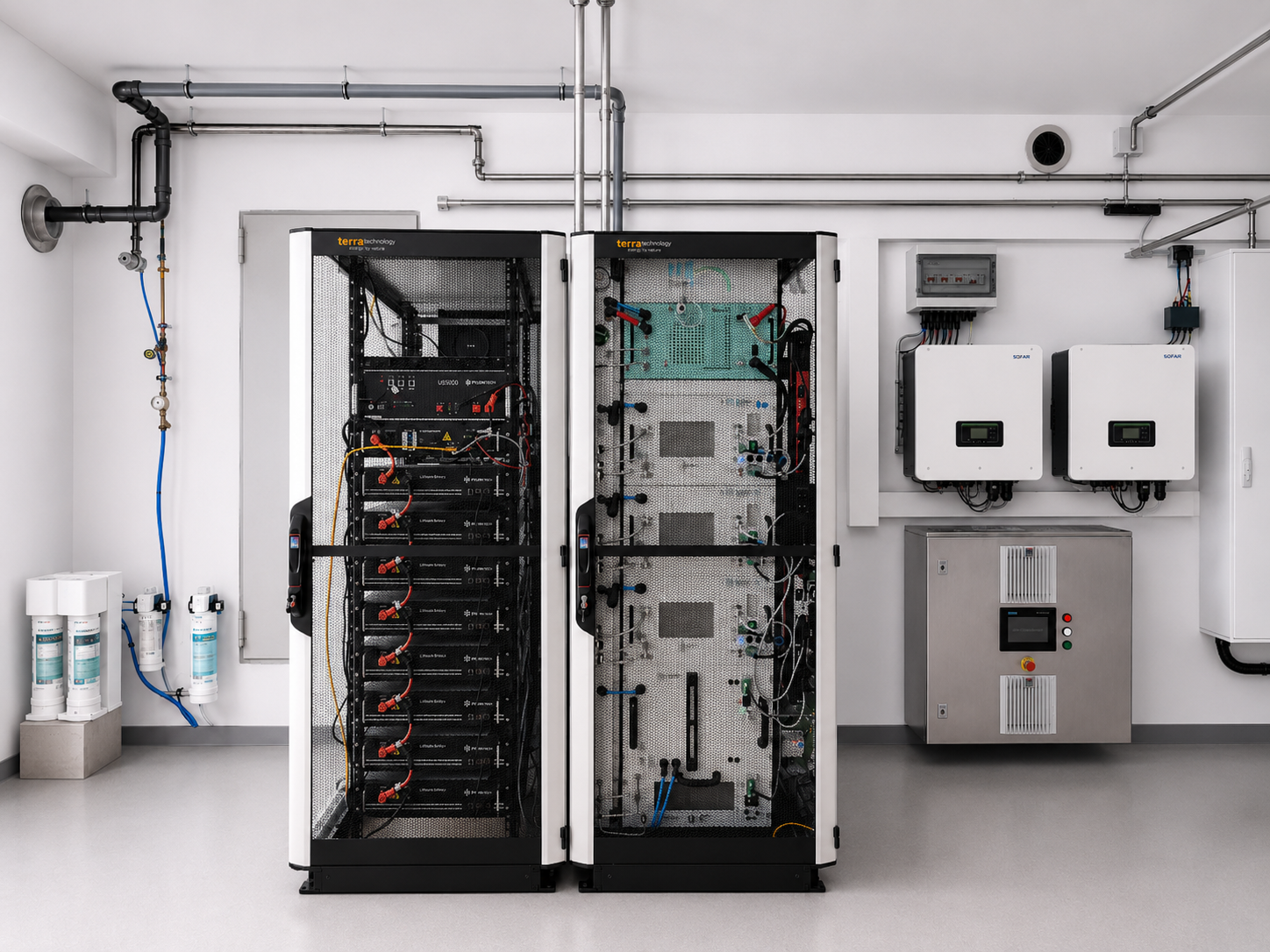
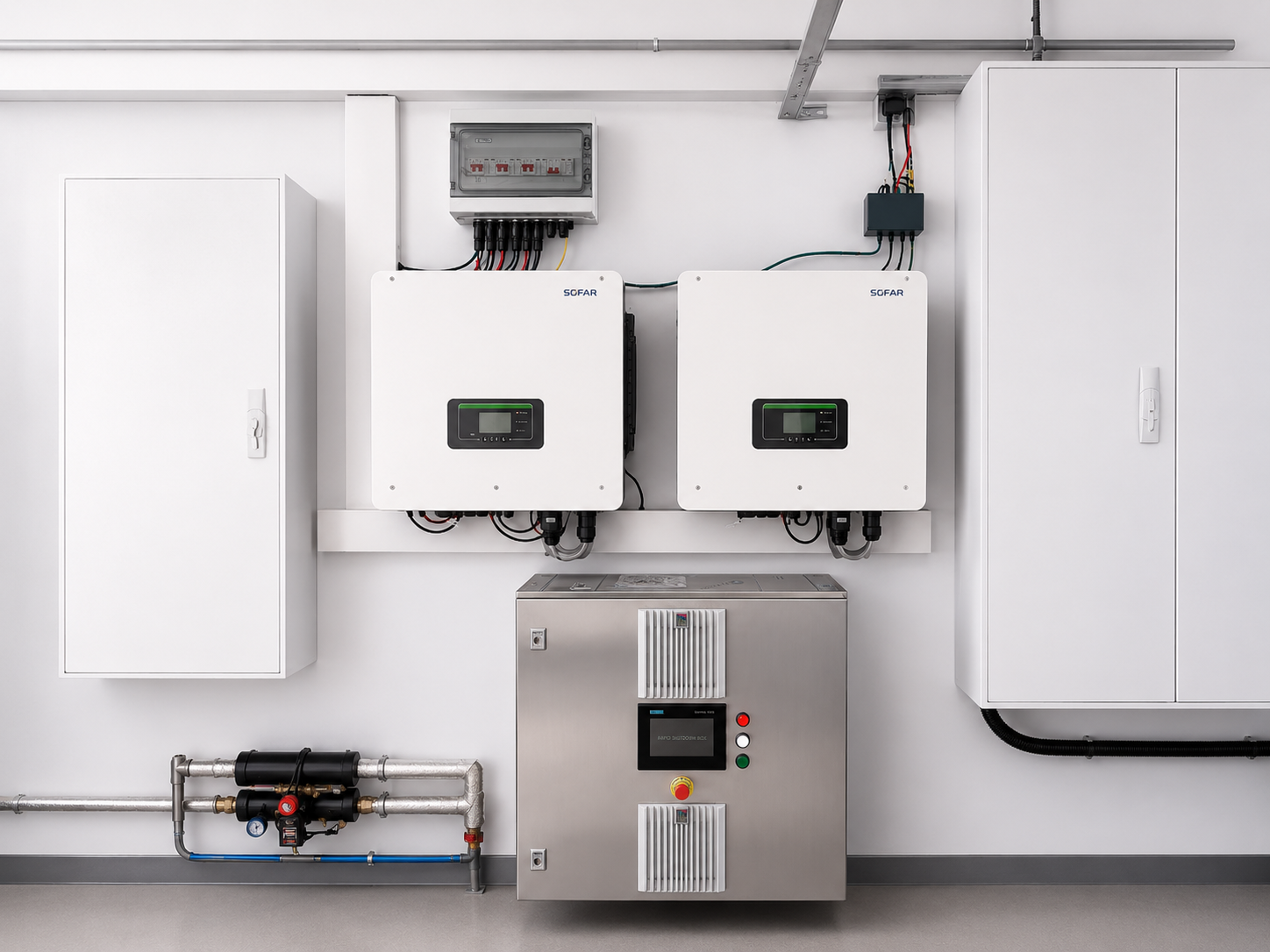
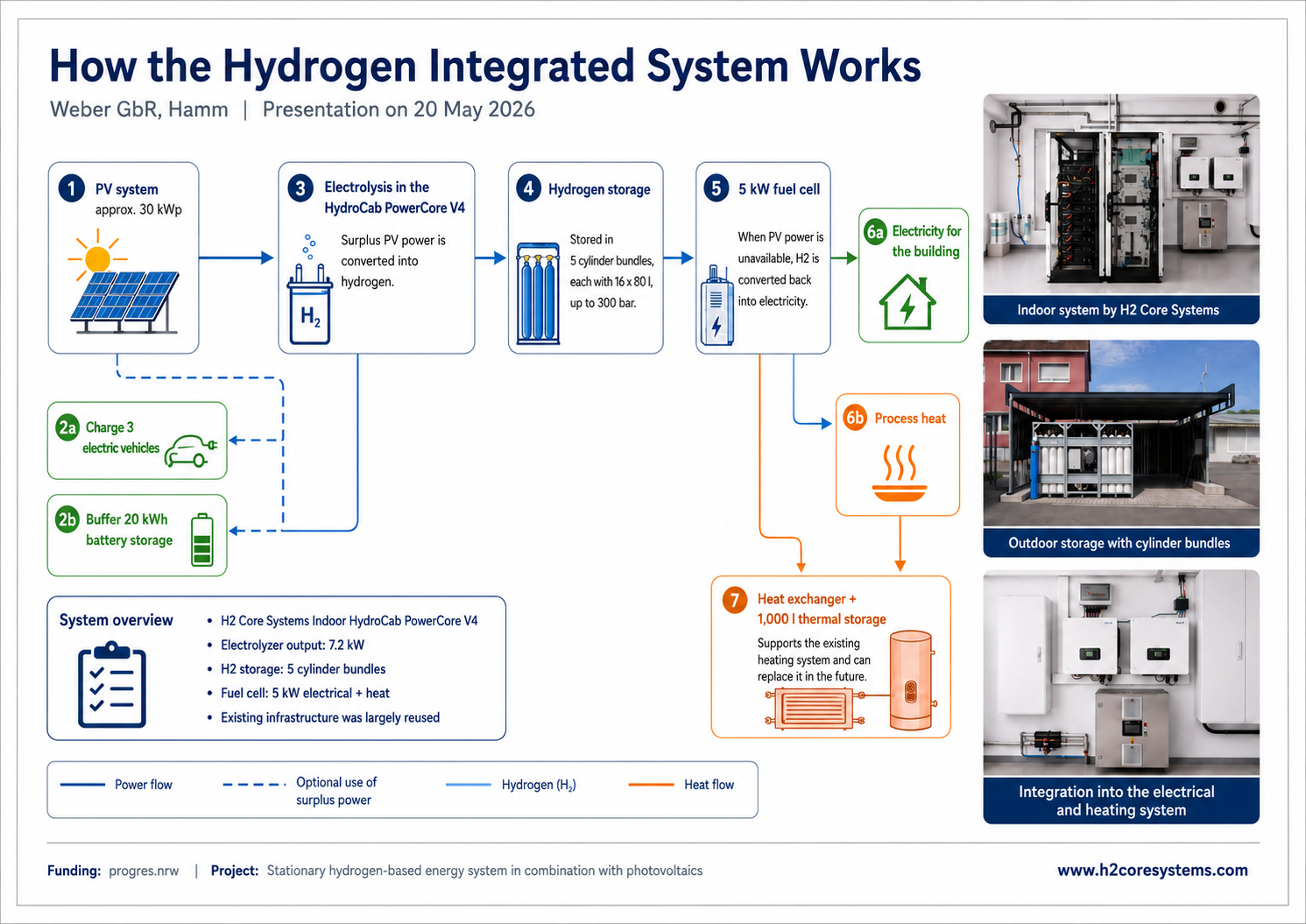
At the center of the project is an indoor HydroCab PowerCore from H2 Core Systems. The system was installed with three electrolyzers, one fuel cell, and a dryer. The system complements an existing photovoltaic installation of around 30 kWp and makes it possible to use surplus solar power flexibly: first for charging three electric vehicles, then for storage in a battery storage system, and beyond that for conversion into green hydrogen.
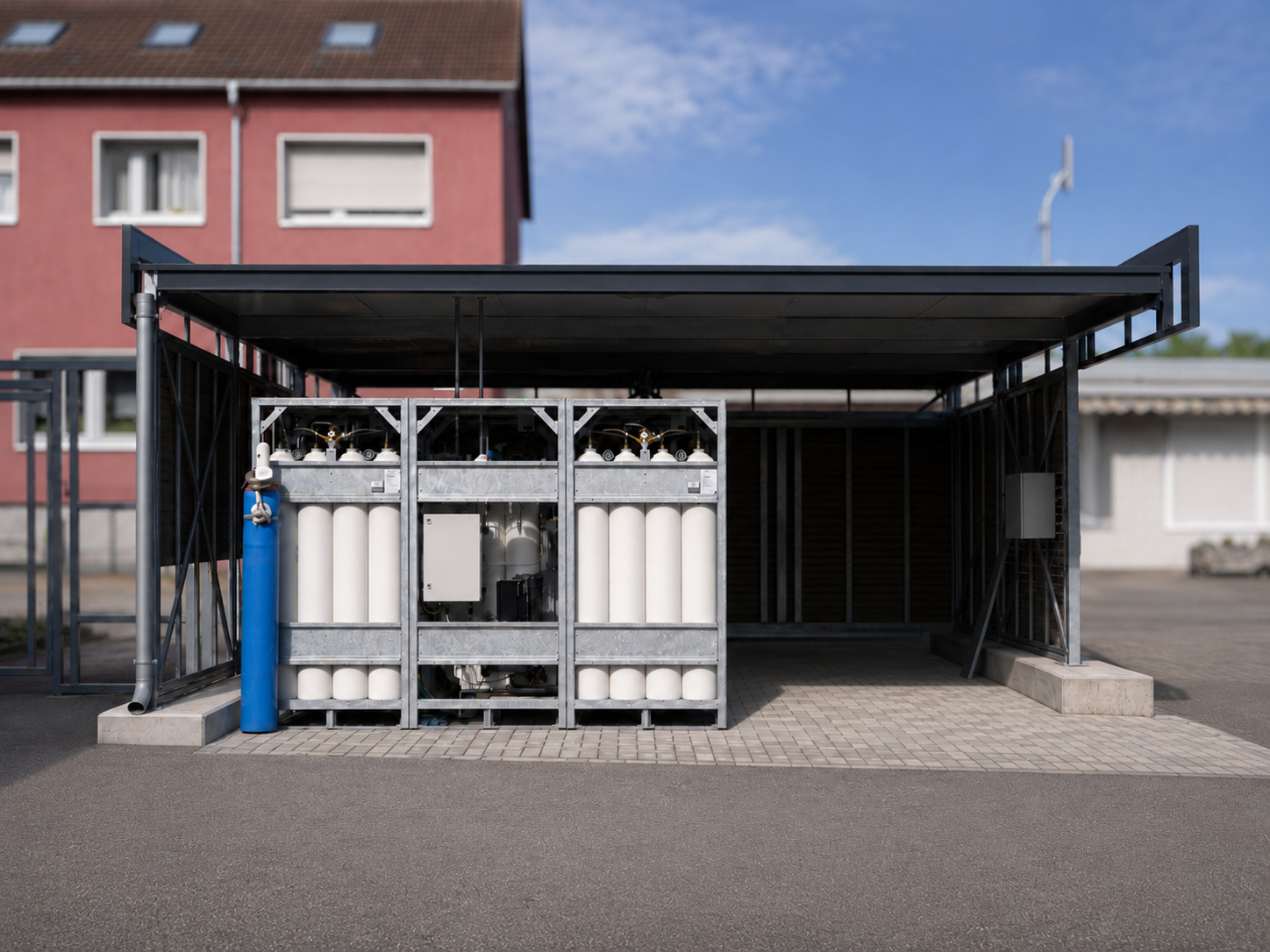
The hydrogen produced is stored in several cylinder bundles and, when needed, converted back into electrical energy via a fuel cell. At the same time, the resulting process heat is integrated into a 1,000-liter water storage tank via heat exchangers. This allows the existing gas heating system to be supported and, in the future, partially or fully replaced.
“Our goal was not to abandon the existing infrastructure, but to develop it further in a meaningful way,” says Wolfgang Weber, customer and operator of the system. “With the new solution from H2 Core Systems, we can make much more comprehensive use of our PV electricity – for mobility, power supply, hydrogen storage, and heat. It is precisely this connection that makes the project so valuable for us.”
The project has a special background: since 2024, a hydrogen system from the insolvent manufacturer Home Power Solutions had already been located at the Weber GbR site. Following the insolvency, Weber GbR decided to commission H2 Core Systems with the commissioning, conversion, and technical development of the existing system. A key objective was to reuse as many existing components as possible. These included parts of the storage system, the compressor unit including sensors, existing pipe and cable sections, and the battery storage system for buffering solar energy.
Central system components such as the control unit, the electrical connection to the building distribution network, the electrolyzer system, the fuel cell, and the integration of the fuel cell cooling system into the building’s internal heating network were replaced and newly integrated. The previous residential ventilation system was not continued, as no additional oxygen supply into the living spaces is required.
“This project shows very clearly how hydrogen technology can be used in the building sector – not as a vision of the future, but as a functioning on-site solution,” explains Ulf Jörgensen, CEO of H2 Core Systems. “It was particularly important to us to preserve the customer’s existing infrastructure as much as possible while at the same time building a modern, safe, and scalable energy system. This is precisely where the strength of modular hydrogen systems lies.”
The installed HydroCab PowerCore is based on a modular system approach that combines electrolysis, hydrogen treatment, storage connection, and fuel cell utilization. H2 Core Systems describes the HydroCab PowerCore as a complete energy storage system that combines hydrogen and battery systems and can be integrated into existing PV, wind, or hydropower systems. The system is modularly scalable and designed for both short-term and long-term energy storage.
Technically, the system implemented at Weber has an electrolysis capacity of around 7.2 kW and can produce up to 3 kg of hydrogen per day. The installed fuel cell provides 5 kW of electrical output and also supplies thermal energy, which is integrated into the heating circuit. Hydrogen is stored in five cylinder bundles, each containing 16 cylinders of 80 liters at up to 300 bar.
“The particular challenge was to convert an existing system in a technically sound way while reusing as many components as possible,” says Julian Suteu, Project Manager at H2 Core Systems. “We coordinated the electrolysis, fuel cell, control system, safety and heat integration, and compressor control. This created an overall system that intelligently connects the existing PV system, battery storage system, hydrogen storage system, and heating circuit.”
For the City of Hamm, the project is also a visible example of how decentralized energy solutions can be implemented at the local level.
“Projects like this show that the energy transition in Hamm does not remain abstract, but is arriving in a very practical way at companies, properties, and among people on the ground,” says Marc Herter, Mayor of the City of Hamm. “The combination of photovoltaics, hydrogen storage, electromobility, and heat utilization clearly demonstrates the potential of innovative, decentralized energy systems.”
With the system at Weber GbR, surplus solar power is not only used in the short term but is also made seasonally storable. This means that green hydrogen can contribute to power and heat supply, especially when there is currently insufficient PV generation available. The project therefore combines climate protection, security of supply, and higher self-consumption of energy at a real customer site.
CLICK TO ZOOM